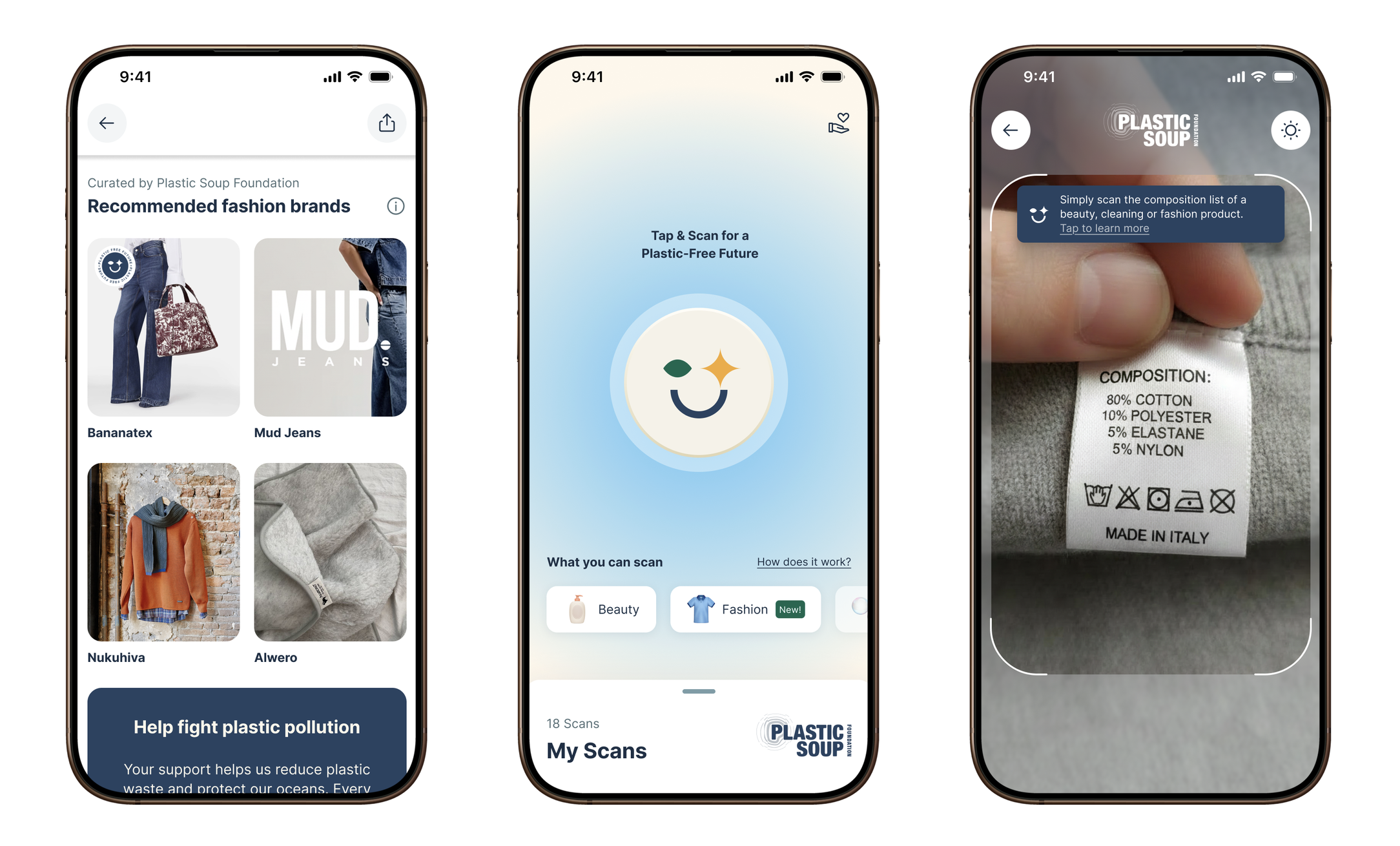
An ingredient list you can barely make sense of. A clothing label full of material names and percentages. For Plastic Soup Foundation, important information lies in there. For the average consumer, mostly a lot of small print. They just want an answer to a simple question: how much plastic is in the product I'm holding?
PlasticFreeFuture makes that information immediately usable. Point your camera at an ingredient list or material label and the app reads what it says, interprets the information and translates it within seconds into understandable advice. Ninjible built the app and the technology behind it; Accenture developed the design. Curious?
📲 Download PlasticFreeFuture now in the App Store or in Google play.
From photo to reliable advice
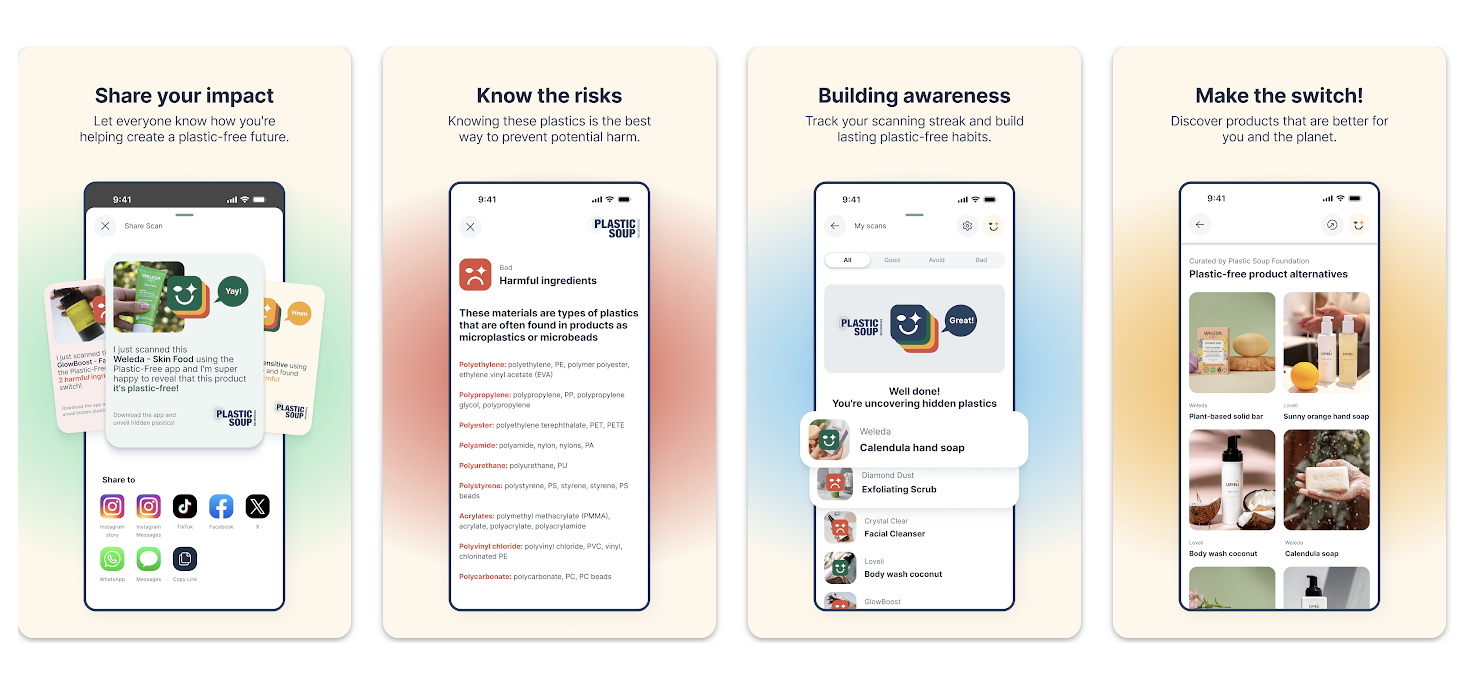
Especially with clothing, quite a lot of technology is involved. From a photo of a label to recognised materials and percentages, and from that information to a substantiated assessment. For that, OCR, AI, assessment rules and the technology behind the app must work together seamlessly.
From complex product information to one clear choice
Plastic Soup Foundation has a great deal of knowledge about microplastics and plastic use. But that knowledge only has real value for consumers when it is available at the moment someone makes a choice.
For example when you're standing with a bottle of shampoo in your hand.
With PlasticFreeFuture you point your phone's camera at the ingredient list. The app reads the ingredients, recognises which substances are in it and checks them against Plastic Soup Foundation's knowledge and assessment methodology. You then immediately get an understandable result and can discover plastic-free alternatives.
No picking apart ingredient lists. No searching a complicated database. Scan and know where you stand. That principle formed the basis of PlasticFreeFuture from the start.
The next step: scanning clothing
With the new functionality, Plastic Soup Foundation applies the same principle to fashion. Instead of an ingredient list, the user scans the material label of a garment. The app reads, for example, that a shirt consists of cotton, polyester and elastane, recognises the different materials and percentages and translates that information into a judgement about the amount of plastic in the garment.
The user doesn't need to know which fibres are synthetic or add up percentages themselves. The technology does the work in the background. And that's where it got interesting.
An AI product scanner has to do more than recognise something
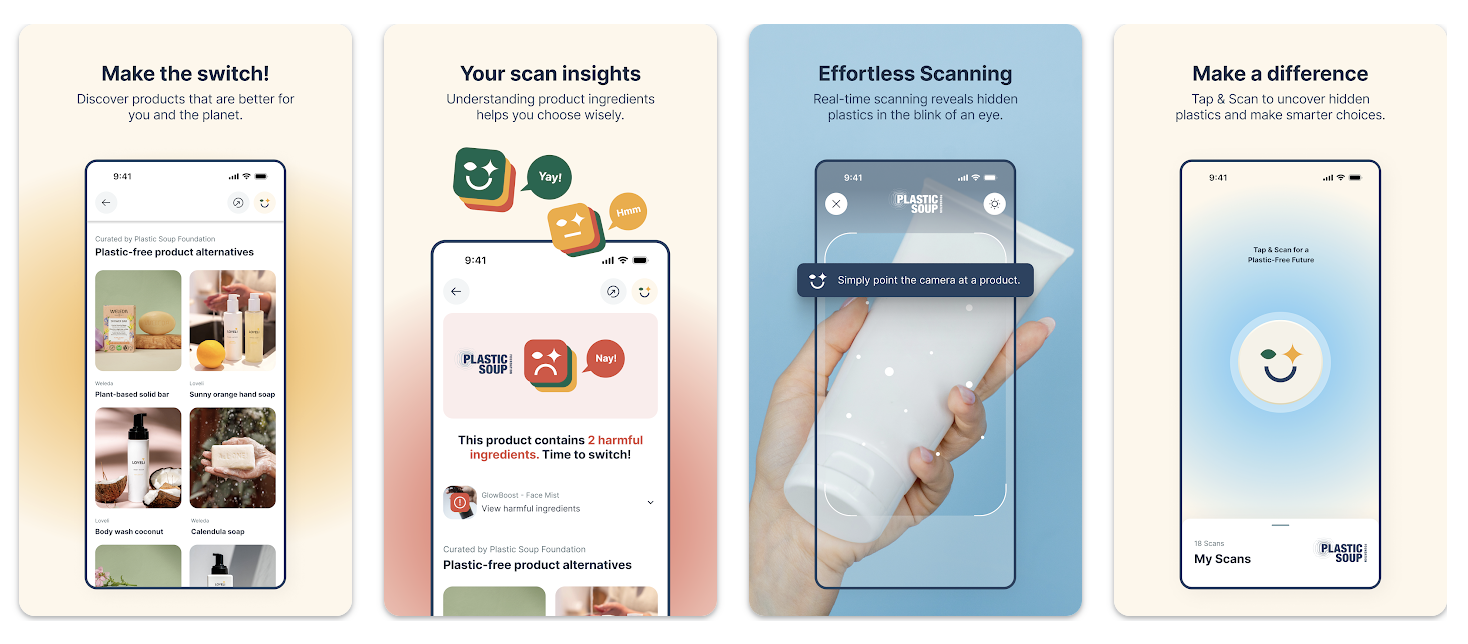
Pointing a camera at a label is one thing. Building an app with scan functionality that turns that photo into a reliable and usable outcome within seconds is something else. The scan goes through several steps for this. OCR extracts the text of the label from the image. AI and image recognition help to recognise and interpret the different materials and percentages. That information is then linked to Plastic Soup Foundation's substantive assessment logic.
After that, the app does perhaps the most important thing: making all the technology disappear from view again. In the end the user doesn't see an AI model, OCR result or complicated material analysis, but a simple conclusion: Yay, Hmm or Nay.
AI doesn't decide what is good or bad
That distinction is important. Within the fashion scanner, AI is used to understand the information on the clothing label. But an AI model doesn't decide on its own whether a product deserves a Yay, Hmm or Nay.
The assessment rules come from Plastic Soup Foundation. The technology makes sure that information from the real world can be recognised and held against those rules. That makes AI here not a gimmick, but one part of a larger digital product. That's also exactly where the difference lies between experimenting with AI and building an AI application that can actually be used in practice.
“The assignment sounds simple at first: make sure the app can scan clothing too. But the real challenge lies in everything that happens afterwards. How do you go from a photo of a label to an outcome that is substantively correct and that someone in a shop understands immediately? AI helps us recognise and interpret. The product around it makes sure someone actually gets something out of it.”
René Vetter, Ninjible
Not everyone will be happy with the result
Plastic in clothing thus becomes much more visible to consumers.
“We're proud of what's there now, but not everyone will be happy with it. Big fashion brands, and certainly ultra fast fashion chains, will look at this app with suspicion. Clothing with a lot of synthetic materials in particular comes out less well. The app simply shows what's in it.”
René Vetter, Ninjible
And that was exactly the point: not making complex information even more complicated, but reducing it to something with which someone can make their own choice.
PlasticFreeFuture is more than a scanner
On the front end, PlasticFreeFuture deliberately feels simple. Open camera. Scan. Get result. Behind it sits a digital product in which various components have to work together: the mobile app, OCR and AI, assessment logic, product information, alternatives and the backend in which Plastic Soup Foundation manages its content.
Ninjible built PlasticFreeFuture as part of Plastic Soup Foundation's broader digital ecosystem. The app is thus not separate from the rest of the digital environment. The website, the CMS, data and other functionalities also have to connect well. In the Plastic Soup Foundation case you can read how Ninjible, together with Accenture, renewed the broader digital ecosystem.
As a result, with new functionality we don't just look at the feature that has to be added, but also at the systems and data that functionality depends on. Because building a smart scanner is one challenge. Making sure that scanner becomes part of a product that can keep growing is another.
From cosmetics to fashion. And then?
The step from cosmetics to clothing also shows why we didn't approach PlasticFreeFuture as a one-off scanner. The product category changes. The information on the label changes. The way an assessment comes about changes. But the underlying principle remains standing:
Scan something from the physical world → recognise information → interpret → combine with own data and rules → immediately show a usable outcome.
That principle is not reserved for cosmetics or clothing. Think of an app that scans a package and returns information from your own product database. An inspection tool that recognises a label or document and immediately determines the right next step. Or an application where employees scan an object and get information back from various business systems.
Not every application needs the same technology for this. Sometimes OCR is enough. Sometimes you need image recognition, AI, your own database or integrations with existing systems.
The interesting question is therefore not whether AI can recognise something. The interesting question is what you want to do with that information afterwards.
Want an app with scan functionality built?
PlasticFreeFuture started with a concrete problem: how do you make Plastic Soup Foundation's knowledge usable for someone who is about to buy a product? The answer became an app that can scan, recognise and interpret something from the physical world and links directly relevant information to it.
That principle goes much further than cosmetics or clothing. Think of packaging, labels, parts, documents, machines or other objects. Your camera becomes the gateway to product data, a database, business rules or information from other systems.
Do you have an idea for an app in which users must be able to scan something and immediately know what it is, what's in it or what should be done with it? Then the interesting part only begins after the scan. Which information has to come out? Which data and systems are needed for that? And how do you turn image recognition, OCR, AI and existing systems into one scan functionality that feels very simple to the user? That's exactly the kind of digital product we love to build at Ninjible.